AI briefing — 12 November 2026
Google launches a low-latency decision API, while new research examines multi-agent failure and Chinese labs push long-context models.
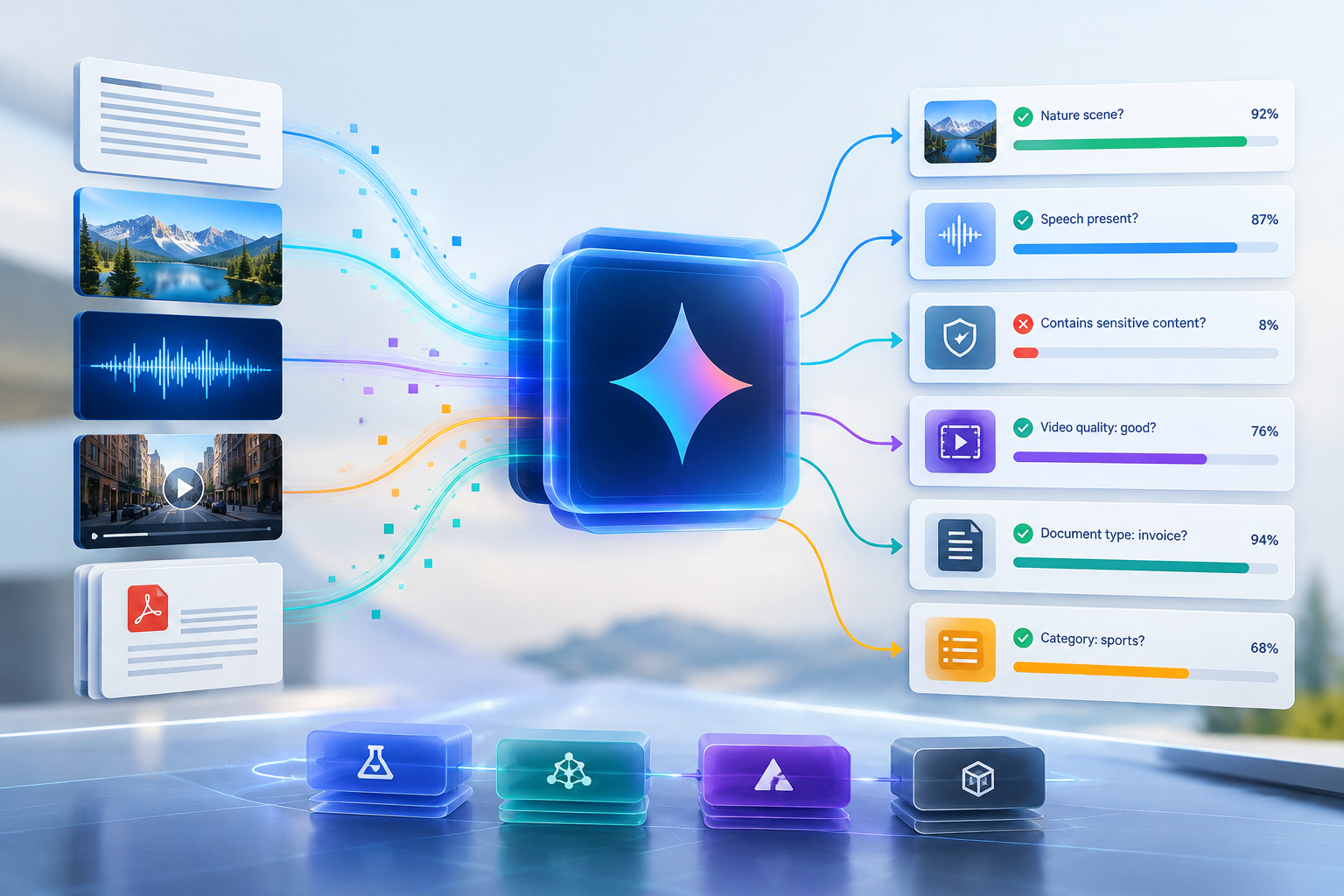
AI-generated editorial illustration.
The strongest developments from approximately the previous 24 hours include specialised decision models, cell-specific genomics, enterprise agent platforms, and a new wave of Chinese model releases. Several widely circulated Nvidia and IPO claims remain insufficiently verified and are excluded.
1. Google launches Gemini Decisions API for fast multimodal classification
Google DeepMind introduced the Gemini Decisions API, powered by the new Gemini Decision 1 model. The endpoint is designed for closed-set decisions rather than open-ended text generation: developers can submit text, images, audio, video or PDFs and ask up to 1,000 yes/no, choice or rubric-scoring questions in one request. Google says the system returns probabilities and confidence scores with 150–250 millisecond end-to-end latency, supports inputs up to 256K tokens, and charges $0.10 per million input tokens with no output-token fee. The API is available through Google AI Studio, with integrations rolling out across frameworks including LangChain, Vercel and LiteLLM.
Why it matters: This is a notable shift towards purpose-built model endpoints for agent infrastructure. Cheap, calibrated decisions could improve routing, policy checks, tool selection and multimodal screening without using a slower generative model for every step. The practical test will be whether the reported calibration and latency hold on production workloads.
Sources
- Gemini Decisions API: Fast multimodal decisions — Google DeepMind — 2026-11-11
2. AlphaGenome 2 targets cell-specific effects of DNA variants
Google DeepMind announced AlphaGenome 2, a next-generation DNA sequence model intended to predict how genetic variants affect particular human cell types and cellular states. The model connects sequence-level variation with cell-specific gene regulation, rather than treating tissue as a single averaged signal. DeepMind says it can predict a wide range of genomic readouts across hundreds of cell types and is designed to help researchers investigate disease mechanisms. The company also plans to release AlphaGenome 2 Skills for its Antigravity scientific workbench, alongside programmatic access and related atlas resources.
Why it matters: Cell-specific interpretation is central to moving from statistical genetic associations towards plausible biological mechanisms. AlphaGenome 2 could help prioritise variants and experiments, but its predictions remain computational hypotheses: they will need validation in primary cells, molecular assays and disease-relevant systems.
Sources
- AlphaGenome 2: Deciphering how cells read DNA to better understand disease — Google DeepMind — 2026-11-11
- AlphaGenome — Google DeepMind
3. Anthropic commits $100m to train 10,000 enterprise AI engineers
Anthropic announced a $100 million investment in Claude Frontier Academy, a programme intended to train 10,000 “Frontier Deployed Engineers” by the end of 2027. The company says cohorts are already under way with organisations including Accenture, Bain, Commonwealth Bank of Australia, Deloitte, McKinsey, Morgan Stanley and Novo Nordisk. The programme is aimed at people who can deploy frontier models inside business processes, rather than simply use chat interfaces or build prototypes. Anthropic’s announcement comes as enterprise customers increasingly move from experimentation towards agents that operate across internal data, software and operational systems.
Why it matters: The programme reflects a bottleneck beyond model capability: organisations often lack people who can redesign workflows, manage permissions, evaluate agents and operate them safely. It also gives Anthropic a way to shape implementation practices and deepen relationships with large customers, though the programme’s real value will depend on independent evidence of deployment outcomes.
Sources
- Anthropic invests $100 million to train 10,000 engineers and tackle the enterprise AI talent gap — Anthropic — 2026-10-02
4. Anthropic research finds multi-agent teams can perform worse than one shared agent
Anthropic-affiliated researchers published a study of multi-user, multi-agent environments in which separate agents represented different users and had to coordinate over shared resources, code or group tasks. Across four simulated environments, the researchers report that outcomes were worse when each user delegated to an individual agent than when one agent served the whole group. They observed failure modes including stalling as teams grew, overriding other users’ requests and making unsupported claims about other participants. The work tested frontier models from Anthropic, OpenAI and Alibaba, but the authors stress that the environments were simulated and should not be treated as a complete evaluation of real-world deployment.
Why it matters: Agent swarms are often assumed to improve performance simply by adding more parallel workers. This research suggests coordination, authority and shared-state design can instead become bottlenecks. It strengthens the case for evaluating social and organisational failure modes—not just single-agent task success—before deploying agents across teams or shared resources.
Sources
- Worse Together: How Performance Breaks Down in Multi-User Multi-Agent Teams — Anthropic Alignment Science — 2026-11-11
5. Baidu previews ERNIE 5.5 Flash with 280B parameters and one-million-token context
Baidu released ERNIE 5.5 Flash Preview, a post-trained model with 280 billion total parameters and 14 billion active parameters per token. Baidu says it has a one-million-token context window and is designed for coding, 3D modelling, knowledge work and content creation. The model is available through the Qianfan API, while the company says its weights will be open-sourced under the Apache 2.0 licence. Baidu’s demonstrations include long coding tasks, Unreal Engine game development, Blender and CAD workflows, research reports, spreadsheets and video production. These are company-selected examples rather than independent evaluations, and the preview remains an intermediate checkpoint.
Why it matters: ERNIE 5.5 Flash illustrates the continuing Chinese push towards efficient mixture-of-experts systems with long context and agentic tool use. If the promised Apache 2.0 release arrives, developers will be able to test the model locally or adapt it without relying solely on a hosted API. Independent benchmarks and reproducibility will matter more than launch demonstrations.
Sources
- Introducing ERNIE 5.5 Flash Preview — ERNIE — 2026-11-11
- ERNIE models release page — Baidu Intelligent Cloud
6. Alibaba opens a short preview of multimodal Qwen4-Max
Alibaba Cloud made qwen4-max-preview available through its Token Plan and selected Qwen products. The model is positioned as the flagship of the Qwen4 generation, with text, image and video understanding, deep reasoning, tool calling, web search and structured outputs. Alibaba describes it as targeting complex coding, office productivity and long-running agentic tasks. The preview runs from 11 November to 25 November 2026, is subscription-only rather than pay-as-you-go, and will then be retired. Alibaba has not published a parameter count or complete benchmark set for the preview.
Why it matters: The release gives Alibaba a new flagship surface while keeping the first Qwen4 model tightly controlled during evaluation. Its multimodal and agentic positioning increases pressure on Western providers in developer and enterprise workflows, but the limited preview and absence of full technical disclosures make comparisons premature.
Sources
- qwen4-max-preview — Alibaba Cloud — 2026-11-11
- Qwen4-Max preview documentation — Alibaba Cloud — 2026-11-11
7. IBM and Microsoft package industry-specific agents into Imagine Enterprise
IBM Consulting and Microsoft announced Imagine Enterprise, a platform for building, deploying and governing AI agents in regulated and operationally complex industries. IBM contributes more than 6,000 pre-built agents and assets from IBM Consulting Advantage, while Microsoft supplies cloud, data, identity, security and governance components including Azure, Fabric, Entra, Purview, Defender, Microsoft Foundry and Copilot technologies. Initial frameworks target financial services, insurance and retail. The platform is available through IBM Consulting engagements, with self-management options also offered.
Why it matters: The announcement shows enterprise AI competition moving from general-purpose assistants towards packaged deployment systems combining agents, data access, identity and compliance. The large catalogue of pre-built assets could shorten implementation time, but customers will need evidence that these agents are maintainable, auditable and genuinely useful outside demonstrations.
Sources
- IBM and Microsoft Announce a New AI Agent Platform Designed for Industry-Specific Transformation — IBM — 2026-11-10
8. OpenAI begins beta rollout of business listings and Business Agents in ChatGPT
OpenAI introduced Businesses in ChatGPT, a beta product that lets eligible organisations claim business profiles, update information, submit product feeds and view aggregated insights such as mentions and website clicks. Eligible US ecommerce and online-service businesses can also create a clearly labelled Business Agent that answers questions using information supplied by the business. OpenAI says businesses do not receive users’ conversations or Business Agent chats. The company also allows sponsored Business Agents to serve as destinations for ChatGPT advertising, with sponsored placements separated from independent ChatGPT answers.
Why it matters: This is a significant move from AI search and recommendations towards agent-mediated commerce. Businesses may gain a new discovery channel, while OpenAI gains structured commercial data and a route from user intent to action. The main issues to watch are ranking transparency, data accuracy, advertising boundaries and liability when a Business Agent gives incorrect advice or takes action.
Sources
- Introducing Businesses in ChatGPT — OpenAI — 2026-11-10
- Businesses in ChatGPT: Claim Your Business — OpenAI
9. OpenAI sets 11 December deadline for retiring Advanced and Standard Voice
OpenAI says Advanced Voice and Standard Voice will be removed from ChatGPT’s voice model picker on 11 December 2026. Users can continue using them during the transition, after which they will default to GPT-Live. OpenAI says voice usage has nearly doubled since GPT-Live launched in July and that nearly all voice users now use the newer system. Live video and screen sharing will continue to use Advanced Voice until GPT-Live supports those capabilities.
Why it matters: The change consolidates OpenAI’s consumer voice stack around one model and reduces fragmentation in the product. It also illustrates the operational cost of maintaining legacy modes: users who prefer the older voices lose a choice, while OpenAI gains a simpler surface for improving continuity, personalisation and conversational quality.
Sources
- Retiring Advanced and Standard Voice in ChatGPT — OpenAI Help Center — 2026-11-10
What to watch
Watch for independent evaluations of ERNIE 5.5 Flash Preview and Qwen4-Max, the practical rollout of Google’s Decisions API, and early evidence from Anthropic’s multi-agent research in real deployments. Also follow whether OpenAI expands Business Agents beyond eligible US businesses and whether Google releases AlphaGenome 2 access and benchmark details.
Researched and generated with AI. Explore the linked sources for original reporting and context.
Back to all news ↗